How Can Foodservice Buyers Avoid Costly Sourcing Mistakes with 5 Crucial Bamboo Cutlery Quality Tests?
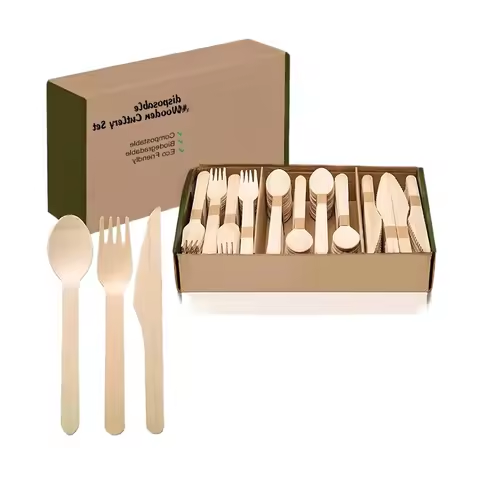
With single-use plastic bans fully enforced across North America, Europe, and Australia, ordering bulk bamboo cutlery has transitioned from an eco-friendly option to a mission-critical purchasing requirement for fast-casual chains, caterers, and distributors.
However, for corporate purchasing directors and import wholesalers, sourcing renewable utensils internationally presents hidden supply chain risks. Low-quality biodegradable bamboo cutlery can mold inside ocean containers during a two-month transit, release foul sulfur odors when submerged in hot broth, or snap unexpectedly into a customer's meal, resulting in costly product recalls and legal liabilities.
Before releasing a deposit to a bamboo cutlery wholesale supplier, your quality assurance team must subject production samples to these 5 rigorous in-house quality tests.
5 Non-Negotiable In-House Quality Checklist
-
Structural Flex and Fracture Resistance Testing: Randomly select bamboo forks and knives from sample boxes of bulk bamboo cutlery and subject them to a 45-degree manual or mechanical bend test. High-grade eco-friendly bamboo cutlery sets utilize dense, parallel bamboo fibers that yield slight flexibility without sudden shattering. Low-grade products made from immature bamboo snap at low pressure, leaving dangerously sharp, splintered edges.
-
High-Temperature Water Immersion and Odor Leaching Check: Submerge bamboo spoons in 195°F (90°C) water for 20 minutes. Inspect the liquid for cloudiness or discoloration, and test for chemical odors. Superior foodservice bamboo utensils release only a mild, natural bamboo aroma. Any acidic, sulfur, or chlorine smell indicates cheaper chemical bleaching agents were used without adequate industrial rinsing.
-
360-Degree Micro-Splinter and Lip Safety Inspection: Rub medical-grade gauze or cotton swabs along the inner fork tines, knife teeth, and spoon rims. If threads snag or tear, the mechanical tumbling and polishing cycles were insufficient. Commercial-grade biodegradable bamboo cutlery requires multiple polishing passes to guarantee smooth, safe edges.
-
Digital Moisture Content and Shipping Mold Prevention Test: Use a pin-type moisture meter to test the core density of the utensils. Moisture control determines container shipping success: acceptable moisture content must be strictly maintained between 8% and 11%. Moisture levels exceeding 12% trigger mold growth during long ocean transits through warm climates, while levels below 7% cause extreme brittleness.
-
Thermal Acid and Heavy Grease Resistance Evaluation: Immerse bamboo utensils in boiling sauce, hot tallow, and high-acid citrus dressing for 60 minutes. Check whether the bamboo absorbs grease rapidly, darkens excessively, or loses structural rigidity. Top-tier foodservice bamboo utensils feature dense fiber structures that naturally resist oil penetration throughout a meal.
Quality Test Benchmark & Acceptance Criteria
| Inspection Test | Fail Criteria | Pass Benchmark (Standard) | Operational Impact |
| Flex & Fracture Test | Snaps under <15° bend, sharp splintered edges | Withstands 30° - 45° bend, smooth fracture line | Guest safety & meal satisfaction |
| Hot Water Leach Test | Water turns yellow; foul sulfur/bleach smell | Clear water, natural bamboo scent only | Food safety & taste compliance |
| Splinter Cotton Test | Cotton threads catch or snag on edges/tines | 100% smooth pass, smooth tines and edges | Lip and tongue protection |
| Digital Moisture Test | Moisture >12% (mold risk) or <7% (brittle) | Strictly 8% - 11% moisture range | Container freight durability |
| Grease & Acid Test | Softens, warps, or absorbs grease within 1 hour | Maintains rigidity, no structural softening | Performance in heavy meals |
Sourcing Best Practices for B2B Importers
-
Verify Factory Certifications: Ensure your supplier holds valid FSC (Forest Stewardship Council) certifications alongside FDA and LFGB compliance test reports.
-
Mandate Ocean Freight Protection: Require desiccant packs in every master carton and sealed moisture-barrier polybags inside cases to protect against ocean container condensation.
-
Establish Clear AQL Contract Terms: Incorporate moisture limits, bend tolerances, and splinter thresholds directly into purchase orders as binding Acceptable Quality Limit (AQL) standards.
Frequently Asked Questions (FAQ)
Q1: Why do some suppliers offer significantly lower prices for bulk bamboo cutlery?
Unusually low prices usually indicate compromised manufacturing: using immature bamboo (brittle), rushing the drying process (high moisture content leading to mold), or using low-cost chemical bleach instead of proper steam sanitization. This leads to high defective rates and customer complaints.
Q2: How can we ensure mass production matches sample quality?
Include these 5 measurable criteria as Acceptable Quality Limit (AQL) standards in your purchase contract. Additionally, require pre-shipment inspection reports (such as SGS or TÜV certificates for moisture level and food safety compliance) before approving final payment.
Q3: What is the shelf life of bulk bamboo cutlery under standard warehousing?
When stored in a dry, ventilated warehouse (relative humidity below 60%), premium bamboo cutlery with controlled moisture levels maintains a shelf life of 18 to 24 months without degradation.
Contact Gorlando
At Gorlando , we manufacture and export premium, fully compliant bulk bamboo cutlery designed specifically for international buyers. Our automated production lines incorporate rigorous moisture monitoring, high-pressure steam sterilization, and smooth edge polishing to meet FDA and LFGB compliance standards.
Whether you need bulk distribution quantities or custom-branded packaging, contact our international sales department today to request a free sample kit and factory-direct quotation!
Paddle Bamboo Skewers vs. Round Skewers: Which One Is Best for Your Food Presentation?