Bamboo Tableware Pricing: The Raw Material Year Behind Your Quote
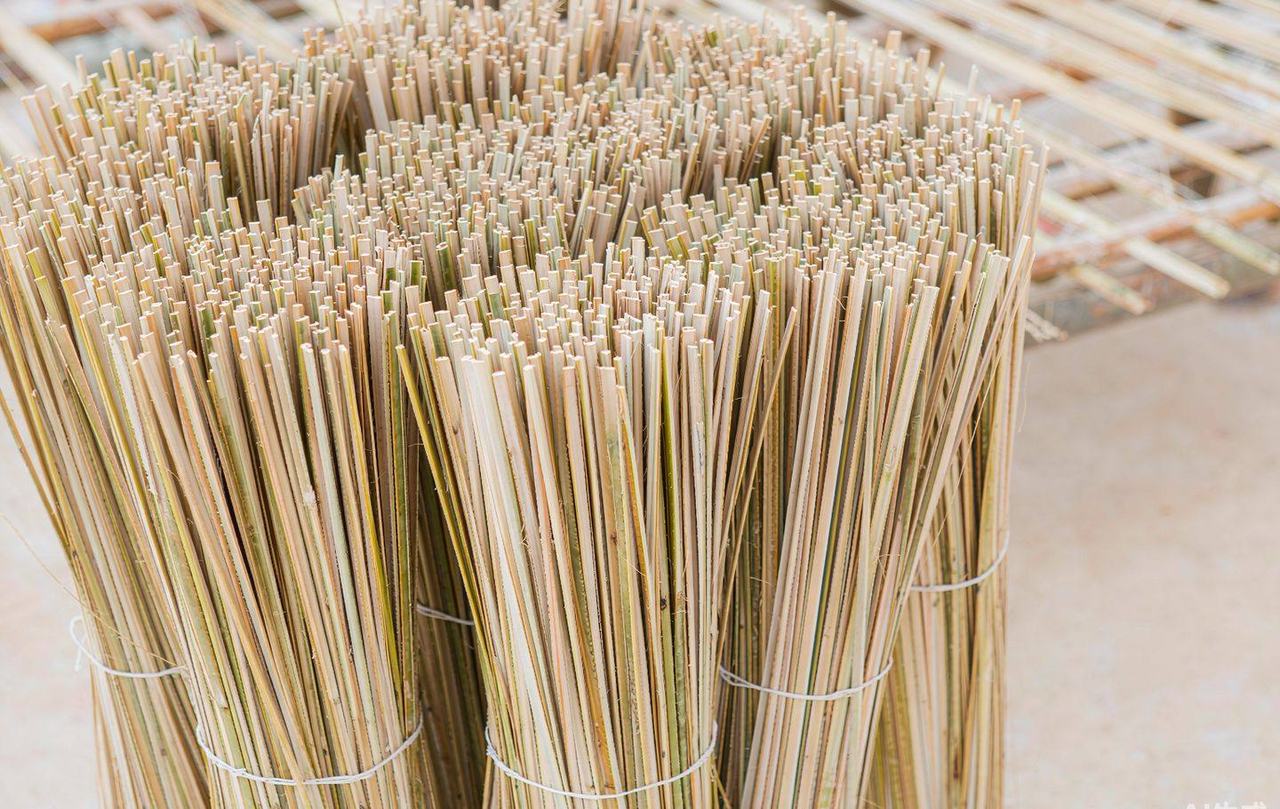
If you are reading this in November, the culm that becomes your March delivery is being cut this month. Not ordered, not quoted — cut. It is felled on a slope somewhere in Fujian or Jiangxi, carried out by hand, trucked to a mill, split, dried and left to rest until the moisture stops moving. By the time it reaches a machine, four decisions have already been made that nobody in your purchasing department was present for, and all four of them are still visible in the carton you open in April.
This is the part of bamboo tableware pricing that a quote cannot show you. Unit price is usually discussed as if it were a negotiation between two offices. In practice it is a record of what happened upstream: when the bamboo was cut, how old it was, how far it had to travel, and how carefully it was dried. The machining, the polishing, the packing and the freight all come afterwards, and all of them are things you can audit. The first four are not, which is why they are worth understanding.
A note on scale before we go further. China holds roughly 7.56 million hectares of bamboo forest — about a fifth of the world total — and produces around 150 million tonnes of culm a year. Eight provinces account for nearly 90 percent of that area, and Sichuan and Fujian each turn over more than 100 billion yuan a year in bamboo products. That is a very large, very mature supply base. It is also a supply base that is seasonal in ways that a spreadsheet does not capture.
Quarter one: the cutting window
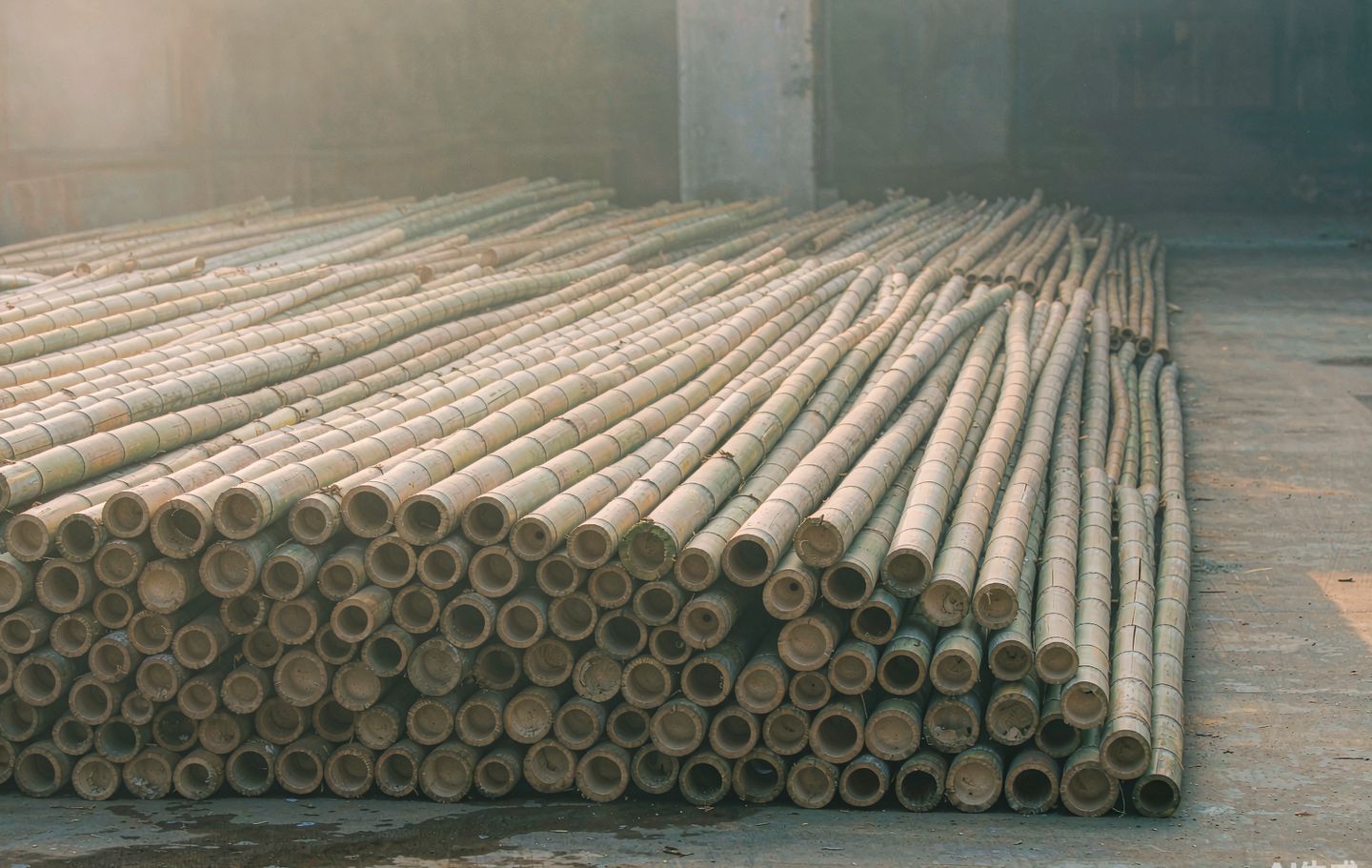
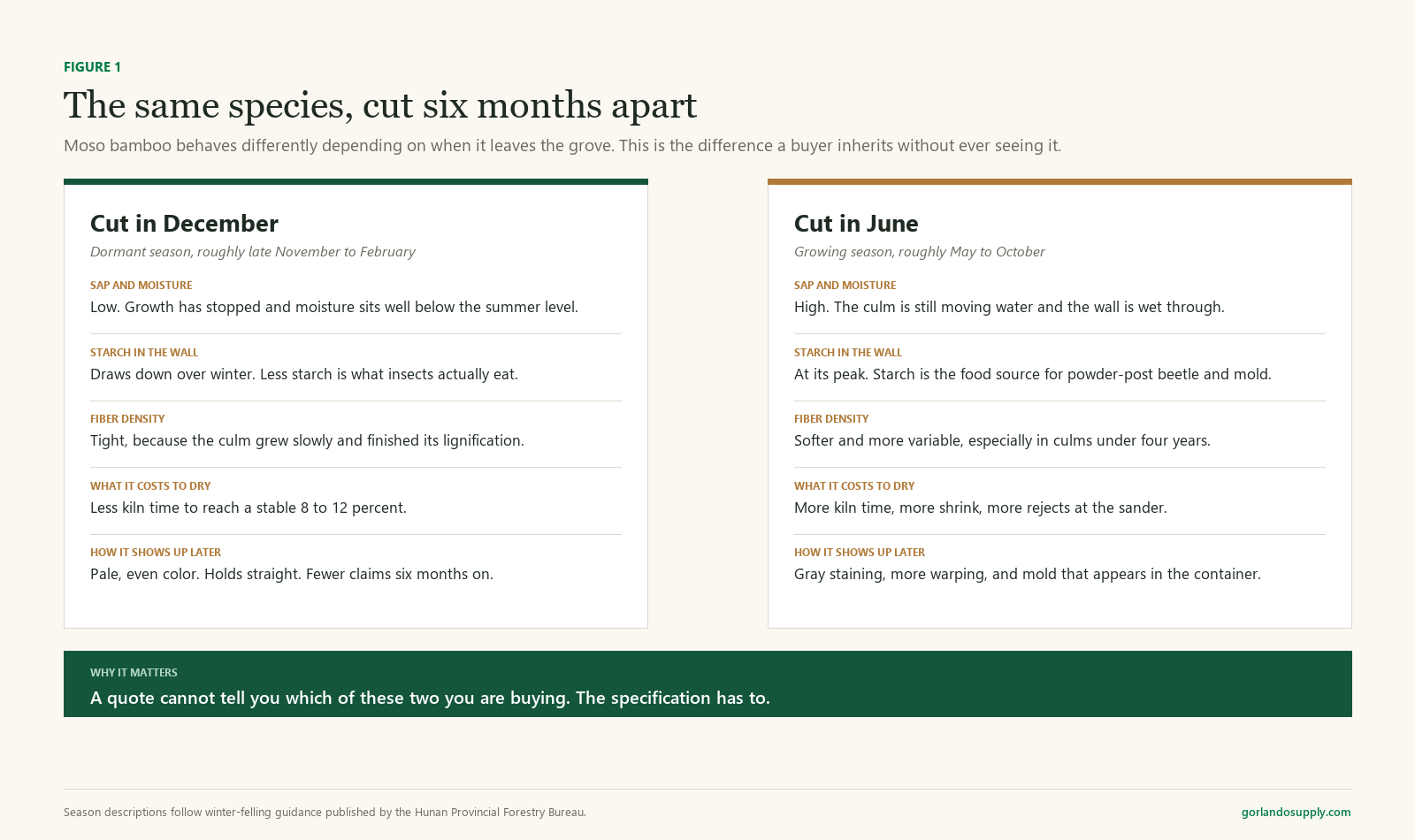
Felling in the main moso regions runs from late November through February, and stops when the shoots come up. This is not a marketing story about "winter bamboo". It is a materials argument, and the provincial forestry guidance in China says it plainly: in winter, growth has stopped, the plant's reserves sit in the rhizome rather than the culm, moisture content is at its lowest, and the fiber structure is at its tightest. Winter-cut culm is denser, straighter and stronger than the same culm cut in June.
There is a second effect that matters more commercially. Most pests that attack bamboo overwinter at the base of the culm or in the litter around it. Cut in winter, when they are dormant and concentrated, and the culm escapes the boring damage that summer-cut material picks up on the way to the mill. Cut in June and you are shipping their food supply along with your product.
What this means for a quote
Material cut between November and February is bought, dried and held. Material cut outside that window is bought because someone needs it, which is a different price conversation. When a supplier tells you a February quote is firm and a July quote is "subject to raw material", that is not an excuse. It is a description of two different inventories.
The age rule nobody writes into a PO
Bamboo reaches its full height in a single growing season — a moso culm can put up twelve to fifteen metres in a few months — but it takes four to five years for the wall to lignify enough to hold an edge. The traditional Chinese marking rule for moso is usually summarized as cun san, qu si, bu liu qi: leave anything under three years, fell selectively at four, fell at five and six, clear everything over seven. Young culm is soft and shrinks. Old culm has gone brittle and grey.
A culm is marked before it is cut, and the mark is a painted band at chest height in most groves. That marking record is the single most useful document a buyer never asks for. If a supplier cannot tell you the age class of the material in your order, the honest assumption is that it is mixed — and mixed material is where inconsistent breakage comes from six months later, when the complaint lands on your desk rather than theirs.
Quarter two: the weeks when nobody is felling
Shoots emerge from late February into April, and in most groves the saws stop. You do not cut the culm that is standing next to a shoot you are trying to grow, and you do not put a truck on a slope that is being worked for the next crop. Felling restarts once the shoots have hardened off.
What does not stop is the mill. Splitting, drying, machining and packing run straight through, drawing on the stock that was built between November and February. This is why a factory's Q2 capacity has very little to do with Q2 raw material. It has to do with how much material it was willing to buy and store in January, and how well it stored it.
For a buyer, the practical consequence is a window. Orders placed in March and April for delivery in June and July are being filled from winter stock. If that stock was bought well, quality is stable and price is predictable. If the factory is buying spot material in April to cover a shortfall, the culm is either last season's (older, grayer, more brittle) or early-season (younger, wetter, more prone to warping). Neither shows up in a photo.
Quarter three: storage is where the money leaks
Bamboo is a hollow tube with a wall that behaves like a bundle of straws. It takes moisture quickly and gives it up slowly, and the difference between the two rates is where most quality failures begin. The target for strips going into machining is usually a moisture content of 8 to 12 percent, reached in a kiln and then equalized — held, not just dried — so that the outer wall and the inner wall are at the same figure.
The number that decides the claim
Unequal moisture does not fail at the factory. It fails in transit. A strip that leaves at 14 percent with a wet core will lose that moisture across four weeks at sea, shrink differentially, and arrive with a bow that was not there at loading. On a skewer the result is a curve you can see across a carton. On a fork it is a neck that snaps at the first scoop of rice.
This is why the summer months deserve more attention than they usually get. July and August in southern China are hot and humid, the warehouse air is close to saturation, and material that was perfectly dry in February can pick up two or three points of moisture simply by sitting in the wrong building. A factory that re-tests before packing is doing something a factory that only tests at the kiln is not.
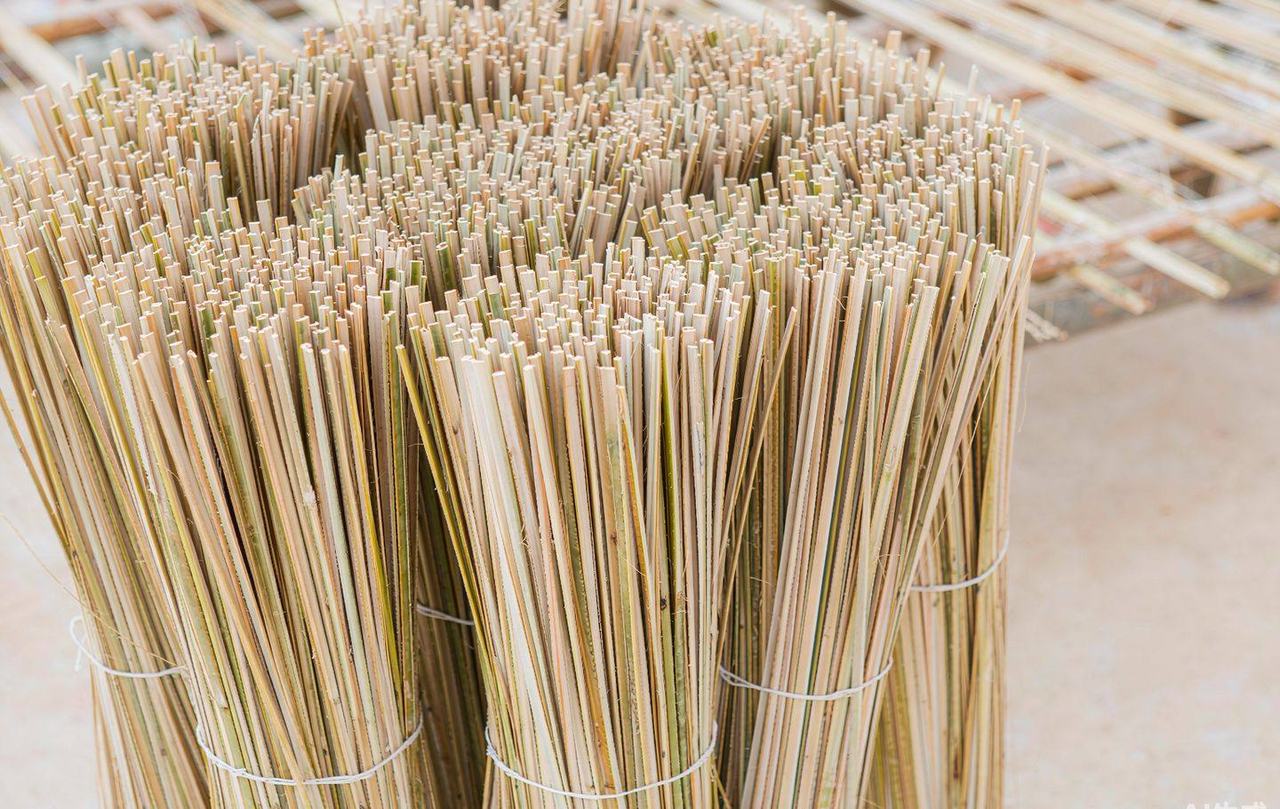
If you are buying for a humid market — the Gulf, Southeast Asia, the US South — ask for the moisture reading that was taken the day the goods were packed, not the one from the kiln log. The two numbers are rarely the same, and the gap between them is the thing you are actually paying for when a supplier charges more for a container that arrives flat. Our own note on mold loss on ocean shipments of bamboo chopsticks goes further into what happens when this step is skipped.
Quarter four: the quote that lands in November
By October the new crop is being marked, and by November it is coming down the mountain — the same window this article opened in, twelve months on. That is the shape of the cycle: the year ends where it began, with a saw on a slope. This is when factories that buy seriously commit their material for the following year, and it is why the quote you receive in November often looks different from the one you received in June. It is not a seasonal surcharge. It is the first price that reflects a known crop rather than a guessed one.
Two things are worth doing with a November quote. First, ask what part of it is material and what part is conversion — a supplier who cannot separate the two is quoting a number, not a cost. Second, ask when the material behind it was cut. A November quote backed by February material and a November quote backed by material cut three weeks ago are different offers at the same price, and only one of them will still look right in July.
What actually moves the number
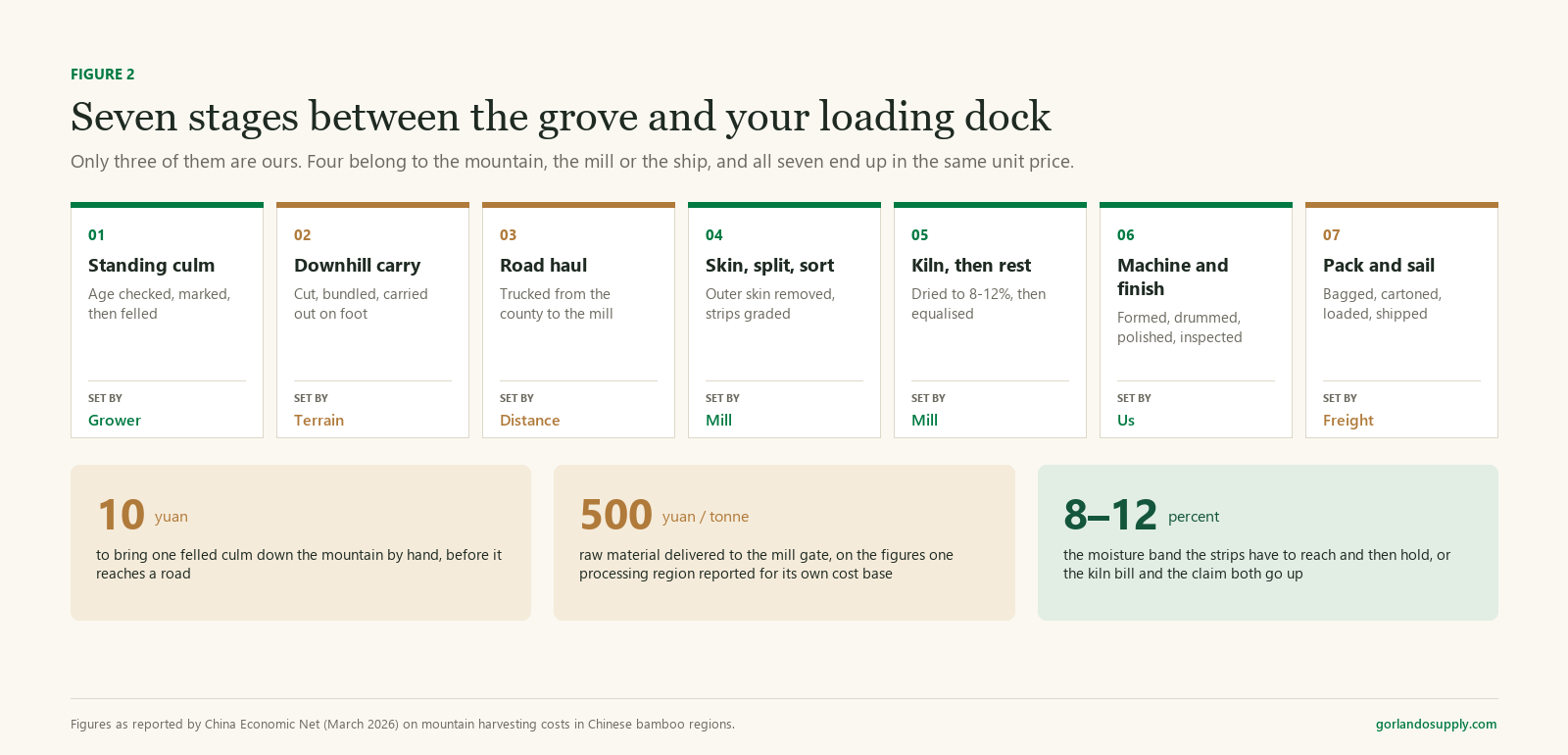
Four inputs sit upstream of every bamboo quote. Only one of them is negotiable in the ordinary sense, and it is not the one buyers usually push on.
|
Input |
What it changes |
Who sets it |
Can you influence it |
|
Cutting window |
Moisture and starch at felling — therefore drying cost, breakage and insect risk |
The calendar |
Only by ordering in the right quarter |
|
Culm age |
Wall density, shrink, and whether the piece snaps at the neck |
The grower's marking rule |
Yes — specify four to five year culm and ask for the marking record |
|
Mountain logistics |
A fixed cost per culm before the mill sees it |
Terrain and distance |
No — and it is the same for every factory in that county, so it is not a differentiator |
|
Drying and storage |
Whether the goods arrive flat and pale, or bowed and blotchy |
The mill, and the warehouse it uses |
Yes — specify the moisture band and ask for the packing-day reading |
The mountain logistics figure is the one that surprises importers. In the main bamboo counties, a felled culm has to be carried out by hand, because the slope is too steep and the ground too broken for anything with wheels. One processing region that published its own cost base put that carry at about ten yuan per culm, and the delivered cost of raw material at the mill gate at roughly 500 yuan per tonne. That is before a single strip is cut. It is also almost entirely labor, which means it tracks rural wages rather than commodity markets — a slow, one-directional pressure that no sourcing negotiation reverses.
How to time a purchase against this
There is no single right month to buy, and any guide that tells you when to order bamboo tableware without first asking what you are buying is guessing. There is a right month for each objective, and they are not the same:
If you need the best material, buy from December stock. Material cut in the window and rested for six weeks before machining is the most stable input available, and the premium for it is smaller than the cost of a rejected container.
If you need the best price, buy before the new crop is priced. Late summer and early autumn orders are usually filled from existing inventory. The number is softer, and you are accepting last season's material, which is fine for skewers and less fine for anything that has to hold an edge.
If you need both, split the order. Take the volume you are confident about from December stock at the firm price, and hold a smaller balance for the February window when the new crop is graded and the price is known. Distributors who do this stop being surprised by their own cost of goods in Q3.
Never place a March order on a verbal price. March is when factories are running winter stock down and deciding what to buy next. It is the month when a price is most likely to be revised, and the revision will arrive as a "freight adjustment" that has nothing to do with freight.
Where this shows up in our own process
We buy from three raw material bases and run roughly twenty 40HQ containers a month out of a 20,000 square metre plant, so the calendar above is not theoretical for us — it is the reason our purchasing desk is busiest in December and quietest in April.
Three practices follow from it, and all three are things a buyer can ask any supplier about:
Material is bought in the window and stored, not bought to order. A factory that buys only against confirmed POs cannot be buying winter-cut culm in June, because there is none for sale at that point at a sensible price. If the answer to "when was this cut" is always "recently", the material is spot material.
Moisture is checked twice. Once at the kiln, once on the day of packing. For bamboo skewers and flat skewers, the second reading is the one that predicts how the carton opens. The same applies to bamboo coffee stirrers, where a two-point moisture difference is enough to change how the stick behaves in a hot drink, and to bulk-packed toothpicks, which sit in an open bucket picking up whatever the room is holding.
Age is written on the batch record, not assumed. When a customer asks why our wooden and bamboo cutlery holds a neck better than a cheaper sample, the answer is usually the age class of the culm and the drying, in that order — not the polishing. Polishing is what makes a piece feel finished. It is not what makes it survive, which is why our own note on splinter-free skewer polishing treats it as a finishing step rather than a strength claim.
None of this is a claim that winter-cut, four-year, well-dried material is the only thing worth buying. Plenty of applications do not need it — a catering skewer that is used once for twenty minutes has different requirements from a fork that has to lift rice out of a 1,000 ml box. The point is that the difference should be a decision, not an accident of when your PO happened to land.
Questions buyers ask
Why is the same skewer cheaper per carton in February than in July?
Because February material is being cut and priced against a known crop, while July orders are filled from stored inventory and spot purchases. The gap is usually the cost of holding material for four months, plus whatever the spot market is doing that week.
Does the cutting season change the color?
Yes, and visibly. Winter-cut culm is paler and more even. Summer-cut culm carries more grey and more variation between pieces, which is why a mixed batch shows banding across a carton even when the dimensions are identical. If carbonized skewers are on your list, the starting color matters less, but the starch content still does.
How can I tell if I was sold young culm?
Three checks: break a sample at the neck and look at the fracture — young culm tears rather than snaps. Run a thumb along the length after polishing — young material raises fuzz that comes back. Measure the diameter at both ends of ten pieces — young culm tapers unevenly. Any one of these is a hint; two together is an answer.
Is bamboo pricing volatile?
Less than timber, more than plastic. The material cost is dominated by labor rather than commodity trading, so it moves slowly and in one direction. What moves quickly is availability, and availability is what shows up as a surcharge in a tight month.
Does certification change the price?
FSC chain of custody adds documentation and audit cost, not material cost. If a supplier quotes a large premium for it, ask what the certificate number covers — the answer is sometimes a different product line. We hold FSC, SGS and FDA documentation for the ranges we export, and the cost of that sits in the paperwork, not in the culm. The bamboo-or-wood question is a separate decision, and our bamboo versus wood framework covers it on its own terms.
The one question worth adding to your next RFQ
Everything above collapses into a single line you can add to a specification sheet this week: state the cutting season and age class of the raw material, and provide the moisture reading taken on the day of packing.
Most suppliers will not have the answer ready. The ones who do are the ones whose quotes hold, and after a year of comparing the two, the difference in unit price stops being the interesting number. What you are buying, in the end, is a record of what happened on a hillside eight months earlier — and the factories that keep that record are the ones that can tell you, without guessing, why your April container will open the way it does.
140mm, 160mm or 165mm? Matching Bamboo Cutlery Length and Spoon Bowl Depth to Menu Type
Related Article