Bamboo vs Wood Chopsticks: 2026 Sustainable Purchasing Decision Framework
2026-05-08

In the first quarter of 2026, many catering brands and tableware purchasers have raised a common question: between bamboo disposable chopsticks and wood disposable chopsticks, which one meets sustainable purchasing standards better? This seemingly simple question has no unified answer and has become a core decision-making dilemma for most purchasers. Mixed environmental promotion claims on the market are highly misleading. Judging merely by material labels will easily ignore the environmental differences caused by supply chain details, ultimately affecting compliance ratings and quality control.
With more than a decade of experience in eco-friendly tableware production, we have answered this question hundreds of times, and our conclusion remains consistent: the decision depends on the overall supply chain control capability. Bamboo has innate advantages in carbon sequestration speed and regeneration efficiency, but inferior chemical processes will completely offset these strengths. Fast-growing wood features mature forest management and certification systems, yet it has higher overall carbon footprints due to transportation loading limitations. Essentially, tableware selection is never a competition between materials, but a verification of the full compliance chain covering raw material logging, production processing and waste degradation.
Full-Dimensional Comparison of Bamboo and Wood Chopsticks
To provide reliable basis for purchasing decisions, we have sorted out a comprehensive material comparison table based on the latest 2026 forestry data, international environmental standards and food-contact tableware specifications, with newly added authoritative testing criteria to eliminate subjective judgment.
|
Comparison Dimension
|
Bamboo Chopsticks (Moso Bamboo)
|
Wood Chopsticks (Birch/Poplar)
|
Relevant Industry Standards / Testing Methods
|
|---|---|---|---|
|
Maturation Cycle
|
Ready for harvesting in 3-5 years with recyclable regeneration
|
One growth cycle of 15-30 years with long rotation period
|
—
|
|
Land Output Per Unit Area
|
Annual selective harvesting with high unit-area output density
|
Interval cutting and maintenance required with low unit-area output
|
FSC Forest Management Certification Standards
|
|
2026 Unit Carbon Sequestration
|
Fast carbon fixation rate with significant short-term carbon sequestration advantages
|
Stable carbon sequestration performance with mature long-term forest management system
|
IPCC National Greenhouse Gas Inventories Guidelines
|
|
Moisture Resistance & Durability
|
Strong natural toughness, not easy to bend, moderate moisture resistance
|
Compact wood texture with better durability in dry environments
|
GB/T 19790.2 Disposable Chopsticks Performance Standard
|
|
Main Processing Technology
|
Green removing & polishing, 160-200℃ high-temperature physical carbonization, sterile drying
|
Rotary cutting, constant temperature drying, physical mildew-proof treatment
|
GB 4806.12 Safety Standard for Food-Contact Bamboo & Wood Products
|
|
Degradation Cycle (Industrial Composting)
|
Fully degraded in 3-6 months with no harmful residues
|
Fully degraded in 6-12 months due to slow lignin decomposition
|
EN 13432 Compostable Certification Standard
|
In-Depth Analysis of Core Links: Craftsmanship & Supply Chain Determine Environmental Performance
1. Production Processing: Avoid Craft Blind Spots and Adhere to Compliance Standards
Production processing is the most overlooked environmental blind spot for purchasers, also known as the "craft black box" in the industry. Even for qualified high-temperature carbonized bamboo chopsticks, the environmental performance and safety standards of small workshops and standardized large-scale factories differ vastly, far exceeding the material gap between bamboo and wood.
Many small processing plants adopt extensive processes such as sulfur fumigation and hydrogen peroxide chemical bleaching to cover raw material defects and reduce costs. These methods leave residual harmful substances like sulfur dioxide and formaldehyde in finished chopsticks. In accordance with EU REACH regulations and domestic GB 4806.12-2022 food-contact safety standards, the formaldehyde migration limit is only 15mg/kg, and chemically treated tableware is prone to exceeding the standard. More importantly, unpurified bleaching wastewater and chemical waste liquid are directly discharged, causing soil and groundwater pollution far more severe than standardized wood logging.
Standardized large-scale factories adopt an entirely different production logic. As a professional manufacturer, Gorlando abandons all chemical additives and adopts 160-200℃ inert gas-protected high-temperature physical carbonization technology. It completes bamboo strip color enhancement, sterilization and curing through pure physical methods, eliminating chemical residues from the source. All production wastewater and waste gas are treated through a closed-loop purification system before discharge, fully complying with domestic and foreign food-grade tableware production standards and retaining the natural eco-friendly attributes of eco-friendly bamboo tableware.
2. Logistics Carbon Footprint: Loading Efficiency Reshapes Environmental Ratings
Most people only focus on the environmental attributes of products themselves while ignoring the carbon footprint of logistics. In fact, in long-distance transportation scenarios, the energy consumption gap of logistics can completely reverse the overall environmental scores of the two materials, becoming a key factor in purchasing decisions.
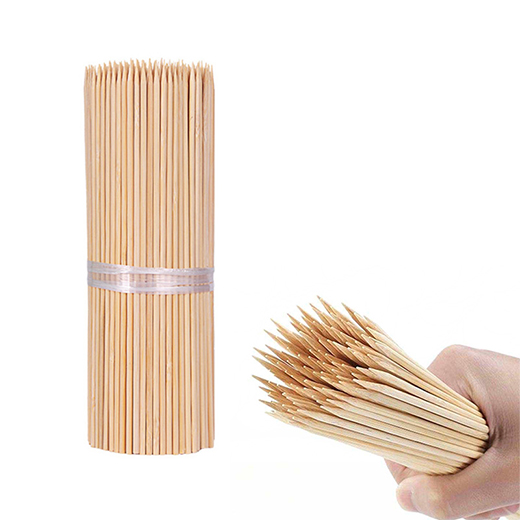
Benefiting from the regular structural characteristics of bamboo, natural disposable bamboo chopsticks feature unified size and standard shape after cutting, with the stacking void rate controlled within 5% and extremely high space utilization. Data shows that a standard 40HQ container can hold 12 to 15 million qualified bamboo chopsticks. In contrast, restricted by natural wood texture and rotary cutting technology, wood chopsticks have slight differences in thickness and radian, unable to stack tightly, resulting in a 10%-15% reduction in loading capacity for the same container.
This means that under the same transportation distance, the carbon emission per unit product of bulk wood chopsticks is much higher than that of bamboo chopsticks. For long-distance transportation orders, this loading efficiency gap further highlights the sustainable advantages of bamboo chopsticks.
3. Waste Degradation: True Degradation Capacity Under Authoritative Standards
The degradation performance after disposal is the final test of tableware sustainability and the core difference between ordinary tableware and eco-friendly tableware. Currently, global disposable degradable tableware takes the EU EN 13432 industrial composting standard as the core certification basis.
The standard clearly stipulates that compostable tableware must break down into fragments smaller than 2mm within 6 months and complete more than 90% biodegradation within 12 months under specified temperature and humidity conditions. Third-party tests show that bamboo chopsticks without chemical additives can completely break down in 3-4 months and achieve 100% natural degradation within 6 months. Wood chopsticks have higher lignin content, which increases the difficulty of microbial decomposition, leading to a longer degradation cycle of 6-12 months.
Some may wonder about their performance in ordinary landfill environments. In fact, the degradation cycle of both materials will multiply in non-industrial composting scenarios. However, qualified products without chemical additives will not produce persistent pollutants or cause long-term damage to soil and groundwater, which is the core advantage of bamboo and wood tableware over plastic products.
Essential Checklist for Bulk Eco-Friendly Chopstick Purchasing
To accurately control purchasing quality and environmental compliance, purchasers can verify item by item according to this checklist to avoid supply chain risks:
-
Verify raw material forest logging qualifications and annual resource maintenance reports to confirm sustainable and compliant raw material sources
-
Check product process test reports to confirm no harmful chemical additives such as bleaching and anti-corrosion agents
-
Verify authoritative environmental and safety certifications matching target markets, including FSC, EN 13432, REACH and FDA
-
Request compliance filing documents for production wastewater and waste gas treatment to verify factory pollution control capabilities
-
Confirm that product outer packaging adopts recyclable and degradable eco-friendly materials to achieve full-link environmental protection
Real Purchasing FAQs
Based on years of customized production and purchasing docking experience, we have sorted out the core concerns of purchasers with practical and non-template answers:
Q: You mainly sell bamboo chopsticks, so why not claim that bamboo chopsticks are absolutely better than wood chopsticks?
A: We sell compliant degradable bamboo chopsticks, not all bamboo chopsticks. No responsible tableware supplier will arbitrarily define material superiority. Material is only a basic carrier, while production technology, quality control standards and supply chain management are the bottom line of environmental protection and safety. We expect customers to choose us for reliable craftsmanship and transparent supply chain, rather than misleading one-sided marketing statements.
Q: How to choose between bamboo and wood chopsticks for bulk orders based on scenarios?
A: The choice depends on your compliance requirements and transportation scenarios. Bamboo chopsticks have obvious data advantages in rapid resource regeneration and low logistics carbon footprint. If your partners attach great importance to the maturity of supply chain certification and prioritize FSC forest certification systems, compliant fast-growing wood chopsticks will pass qualification audits more easily. This is not a competition of material quality, but a choice matching your purchasing compliance priorities.
Q: There are various environmental certifications, which ones should be prioritized during purchasing?
A: Targeted verification can be carried out according to market positioning: prioritize EN 13432 compostable certification and REACH compliance declarations for general scenarios; focus on FDA compliance lists and full GB 4806.12 test reports for food contact safety; take FSC forest management certification as the core basis for supply chain traceability. Complete certifications do not guarantee perfect products, but missing qualifications will definitely bring compliance risks.
Conclusion
This article does not aim to rank the quality of bamboo and wood chopsticks, nor to endorse any material. With over a decade of experience in eco-friendly disposable tableware manufacturing, we always remind ourselves and our cooperative clients: sustainable tableware purchasing is never a simple either/or decision.
Truly sustainable purchasing focuses on the invisible details of factory production: whether raw material logging has complete traceability records? Whether production sewage discharge is fully compliant? Whether the temperature curve of carbonization furnaces remains stable? These subtle production controls constitute the real environmental foundation of tableware products.
As a source manufacturer with 15 production bases and exclusive raw material bases, Gorlando can provide full-link traceability documents, complete authoritative testing certifications and compliant production reports for bamboo chopsticks, while supporting customized services for various specifications of eco-friendly tableware. We hope this detailed decision-making framework helps every purchaser break free from material prejudice and make accurate, compliant and sustainable purchasing decisions.
Color-Coding Toothpicks: Exclusive Hygiene Solution for Shared Appetizer Platters
Toothpicks Quality Grading for Hospitality: What Separates a Good Toothpick from a Bad One