140mm, 160mm or 165mm? Matching Bamboo Cutlery Length and Spoon Bowl Depth to Menu Type
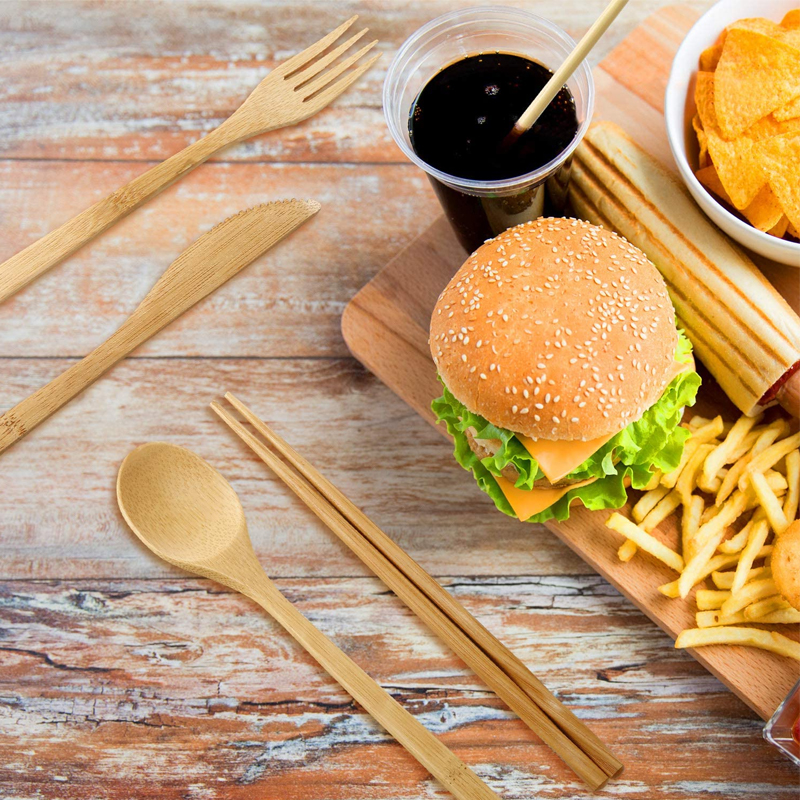
Most buyers choose cutlery length the way they choose a napkin size: by looking at what they bought last time. That works until the container changes. Then the complaints arrive — "the spoon disappears in the soup", "the fork can't reach the bottom of the bowl", "it snaps when I scoop rice" — and nobody connects any of them to a number that was decided two purchasing cycles ago.
This guide treats length as what it is: one of six dimensions that have to agree with your container and your menu. It also makes a claim that will annoy some suppliers: the 5 mm between a 160 mm and a 165 mm fork is not worth paying for unless it crosses a container threshold. Bowl depth and blank thickness decide whether the guest is satisfied. Length only decides whether they can reach.
1. The dimensions that actually matter
A bamboo or wooden fork or spoon has six dimensions worth specifying. Most PO templates capture two of them.
|
Dimension |
Typical range |
What it controls |
|
Total length |
110–190 mm |
Reach into the container |
|
Handle length |
70–130 mm |
Hand clearance above the rim |
|
Bowl depth |
5–10 mm |
Volume per scoop — the top complaint driver |
|
Bowl width |
24–32 mm |
Mouth fit and scoop width |
|
Tine length |
8–14 mm |
Whether the fork actually picks up food |
|
Blank thickness |
1.4–2.0 mm |
Breakage at the neck and under load |
If your spec sheet lists only length, you are specifying reach and nothing else.
2. The standard lengths and who they are for
|
Length |
Head-to-handle ratio |
Designed for |
|
110 mm |
roughly 45 : 65 |
Dessert cups 90–120 ml, ice cream tubs, airline trays, tasting portions |
|
140 mm |
roughly 50 : 90 |
Kids' meals, side salads, 400–500 ml boxes, dessert, coffee-shop add-ons |
|
160 mm |
roughly 55 : 105 |
The default takeaway main — 750–1000 ml rectangular boxes and round bowls |
|
165 mm |
roughly 55 : 110 |
Deep 1000 ml bowls, noodle boxes, soup formats where the food line is high |
|
190 mm |
roughly 60 : 130 |
Catering trays, buffet service, sharing bowls, family-size containers |
Two observations that surprise buyers:
The heads are almost the same size across the range. Going from 140 mm to 165 mm adds 25 mm of handle, not 25 mm of spoon. If the complaint is "the spoon is too small", a longer spoon will not fix it — a deeper bowl will.
Handle ratio matters more than total length in deep containers. A 165 mm fork with a 110 mm handle keeps the fingers above the rim of a 90 mm deep bowl. A 160 mm fork with a 105 mm handle puts the knuckles in the sauce at the same depth.
3. Bowl depth is the specification nobody writes down
This is where most of the guest experience is decided, and where the price difference between two apparently identical spoons usually hides.
Calculating usable volume for an oval bowl of 40 × 28 mm:
|
Bowl depth |
Geometric volume |
Usable per scoop* |
|
5 mm |
~2.9 ml |
~2.5 ml |
|
6 mm |
~3.5 ml |
~3.0 ml |
|
8 mm |
~4.7 ml |
~4.0 ml |
|
10 mm |
~5.9 ml |
~5.0 ml |
*A spoon is never filled to the rim and never fully emptied; usable volume runs about 85% of the geometric figure.
Now put that against a real order. A 350 ml soup at 3.0 ml per scoop is 117 scoops. At 5.0 ml it is 70 scoops. The soup is the same; the experience is not. This single dimension explains the most common negative review of disposable cutlery in soup and dessert applications, and it costs a fraction of a cent per piece to get right.
Practical rule: anything liquid-bearing needs 8 mm minimum. Anything with rice or grain needs 7 mm, because a shallow bowl cannot lift a full load without the grains rolling off. Dry desserts can live with 6 mm.
4. The menu-to-size table
Read this alongside your container supplier's internal depth figures, not the nominal capacity. A "1000 ml" box is often only 55 mm deep; a "750 ml" bowl can be 70 mm.
|
Menu |
Container |
Internal depth |
Length |
Bowl depth |
Tine length |
|
Gelato, 120 ml cup |
Paper cup |
40 mm |
110 mm |
8 mm |
n/a |
|
Kids' meal |
500 ml box |
45 mm |
140 mm |
6 mm |
10 mm |
|
Side salad |
500 ml box |
50 mm |
140 mm |
n/a |
13 mm |
|
Poke bowl |
750 ml round |
60 mm |
160 mm |
8 mm |
12 mm |
|
Rice bowl, bibimbap |
750 ml round |
65 mm |
160 mm |
8 mm |
13 mm |
|
Pasta box |
1000 ml rect. |
55 mm |
160 mm |
8 mm |
14 mm |
|
Ramen, pho |
1000 ml deep |
85 mm |
165 mm |
10 mm |
14 mm |
|
Soup, 350–500 ml |
500 ml deep |
75 mm |
165 mm |
10 mm |
n/a |
|
Curry with rice |
1000 ml rect. |
60 mm |
165 mm |
10 mm |
13 mm |
|
Breakfast bowl, yogurt |
300 ml cup |
55 mm |
140 mm |
8 mm |
n/a |
|
Catering tray, buffet |
Full pan |
65 mm |
190 mm |
10 mm |
12 mm |
|
Airline main |
Retort tray |
35 mm |
110–140 mm |
7 mm |
10 mm |
The rule underneath the table: length should sit between container depth + 25 mm (so the handle clears the rim) and container depth + 60 mm (beyond that the utensil levers over the edge and tips the container).
5. When longer is worse
Buyers default to "longer is safer". It is not, for four reasons:
- Tipping moment. A 190 mm fork in a 500 ml box raises the centre of gravity above the rim; the container tips when the guest lets go of the handle.
- Lid interference. Delivery bags stack. A utensil extending 60 mm above the rim presses into the lid of the box above it.
- Neck breakage rises with length. Bending moment at the neck scales with the overhang. A 190 mm spoon loaded at the bowl sees roughly 40% more stress at the neck than a 160 mm one at the same blank thickness.
- Material cost. Bamboo cutlery is priced substantially by weight. Going 160 → 190 mm adds length without adding function on most menus and lands directly in your cost per 1,000.
6. Thickness: the other half of the story
Length and bowl depth get the attention; thickness decides whether the piece survives the meal.
|
Blank thickness |
Behaviour |
Recommended for |
|
1.4 mm |
Flexes visibly under a full scoop; neck fatigue after one use |
Light desserts only |
|
1.6 mm |
Standard commercial grade; acceptable for rice, salad, dessert |
Takeaway, QSR |
|
1.8 mm |
Noticeably rigid; holds a full soup load |
Noodle, soup, catering |
|
2.0 mm |
Near-rigid; the only sensible choice at 165 mm and above |
Deep bowls, 190 mm service |
Pair the table with the length: 165 mm and above should not be bought below 1.8 mm. A long, thin spoon is the classic "snapped in the bowl" complaint, and it is a specification error rather than a manufacturing defect.
7. Fork and knife dimensions that get skipped
Tine length. Below 10 mm the fork cannot pick up leaves or noodles; the guest stabs twice and gives up. 13–14 mm for salad and pasta, 11–12 mm for rice and protein.
Tine spacing. 3.5–4.0 mm between tines holds noodles without letting rice fall through. Wider spacing looks premium and performs badly.
Knife serration. A bamboo knife is a scoring tool, not a cutting tool. Serration depth of 0.5–0.8 mm on one edge cuts through a wrap, a soft roll or a piece of fish; it will not cut steak, and no specification change will make it. If your menu has steak, the kit needs a different answer.
8. Run this three-step test before you commit
- Buy three lengths. 140, 160 and 165 mm, in your two candidate bowl depths. Twenty pieces each is enough.
- Test with the real container and the real dish. Not water — the actual soup, at service temperature, with the actual fill level. Photograph the handle-to-rim clearance.
- Serve twenty covers. Ask one question only: "was anything difficult to eat?" The answers will cluster on one dimension, and it is usually bowl depth, not length.
Two hours of this replaces a season of complaints.
9. What upsizing costs
|
Change |
Material impact per 1,000 pcs |
Carton cube |
Verdict |
|
160 → 165 mm |
+3% to +4% |
Negligible |
Worth it only for deep bowls |
|
160 → 190 mm |
+18% to +22% |
+15% |
Rarely justified outside catering |
|
1.6 → 1.8 mm |
+12% to +15% |
Negligible |
Buy it for soup and noodles |
|
Bowl 6 → 8 mm |
+4% to +6% |
Negligible |
The best value upgrade on the list |
|
Tine 10 → 13 mm |
+2% |
Negligible |
Buy it for salad and pasta |
The pattern is consistent: spend on bowl depth and thickness, not on length.
10. FAQ
Is 165 mm better than 160 mm? Only if your container's internal depth is above about 75 mm. Below that, the extra 5 mm adds no reach and no function, and you are paying a small premium for a number. Buy 165 mm for deep soup and noodle bowls; keep 160 mm for standard 750–1000 ml boxes.
What length for a 1000 ml round bowl? 165 mm, with a 10 mm bowl and 1.8 mm blank if the dish is liquid-bearing. Measure the internal depth first — 1000 ml bowls range from 55 mm to 85 mm deep, and that range changes the answer completely.
Can one length cover a whole menu? A single 160 mm length covers most takeaway menus reasonably and none of them well. Operators running both soup and salad usually end up with two SKUs: 160 mm for boxes, 165 mm with a deep bowl for liquids. Two SKUs is cheaper than one compromise.
Does bowl depth affect the price much? Four to six percent of material at most. It is the cheapest quality improvement available in bamboo cutlery, and the one buyers most often leave out of the spec.
Are sizes standard across suppliers? No. "160 mm" can mean anything from 157 to 163 mm, and bowl depth is rarely stated at all. Always specify a tolerance — ±1.5 mm on length is normal — and ask for a measured sample, not a catalogue photo.
Gorlando produces bamboo and wooden cutlery in 110–190 mm across 1.4–2.0 mm thickness, with bowl depth and tine length held to drawing, and FSC, BRC, LFGB, FDA and DGCCRF documentation per shipment. Send us your container dimensions and menu list for a matched size recommendation and samples.
Bamboo Tableware Pricing: The Raw Material Year Behind Your Quote
arbonized Bamboo Chopsticks vs. Natural Raw Bamboo Chopsticks: Which Is the Truly Mold-Resistant and Durable Choice for Greasy, High-Temperature Commercial Kitchens?
Related Article