Bamboo Skewers Sourcing & Sizing Guide: How Distributors Match Specs, Prevent Meat Spinning, and Cut Shipping Costs
Anyone in commercial grilling or foodservice distribution knows that bamboo skewers seem like inexpensive consumables, but picking the wrong specification causes endless complaints. Slow prep lines, meat spinning uncontrollably on grill grates, skewers charring and snapping mid-cook, staff puncturing fingers during threading, or entire shipments developing mold during transit—these issues destroy distributor relationships. At Gorlando, as a direct manufacturer of disposable bamboo skewers, we work with thousands of container shipments every year. Here is our practical guide on matching specs, solving kitchen pain points, and protecting wholesale margins.
Skewer Shapes and the Physics of Meat Rotation on the Grill
Whether food turns smoothly over open coals depends on cross-sectional geometry and the friction between bamboo fibers and meat tissue.
Round Skewers: Low Cost and Versatile, but Heavy Meat Cuts Will Spin
Round skewers are the most widely produced option, usually ranging from 2.5mm to 4.0mm in diameter. They pierce easily with minimal resistance and keep production costs low. However, a circular cross-section provides virtually zero rotational torque resistance. While they work well for satay, meatballs, and oysters, threading thick beef steaks, bone-in wings, or pork belly creates a problem: when the chef turns the skewer, the stick rotates while the meat spins in place, charring one side and leaving the other raw.
Flat Skewers: Maximizing Internal Contact Area to Lock Meat Fibers
To eliminate spinning, kitchens rely on flat skewers. Featuring widths between 4.0mm and 6.0mm and thicknesses from 1.2mm to 1.8mm, their flat rectangular cross-section multiplies contact area within the muscle tissue. This creates a mechanical lock so that 100% of the rotational torque transfers to the food. For heavy red meat, lamb chops, pork belly, and whole squid, flat skewers are essential to keep meat turning together with the stick.
Paddle Skewers: Wide Handles for Heat Protection and Stylish Presentation
Paddle skewers, often referred to as gun skewers due to their handle shape, feature a flat tab at the end. This handle allows chefs to grip and flip food rapidly without placing fingers directly over hot charcoal. They are the standard for Japanese yakitori, burger sliders, app skewers, and cocktail garnishes where presentation and heat protection matter.
Recommending basic 3.0mm round skewers to a heavy-meat barbecue chain to save a few cents often leads to customer complaints about meat spinning into charcoal grates. Supplying flat skewers solves this problem entirely.
Ingredient-to-Skewer Specification Matching Matrix
Selecting the right bamboo skewers sizes prevents food splitting, sagging, or snapping under heavy loads.
| Ingredient Category | Recommended Skewer Type | Standard Specs (Thickness/Width x Length) | Selection Logic and Pitfall Prevention |
| Beef / Lamb / Heavy Red Meat | Flat skewers or Heavy-Duty Round | Thickness: 3.5mm - 4.0mm, Length: 25cm - 30cm | High load and heat requirements. Heavy meat requires 3.5mm+ to resist bending; flat skewers prevent spinning. |
| Vegetables / Mushrooms / Tofu | Slim Round or Fine flat skewers | Diameter: 2.5mm - 3.0mm, Length: 15cm - 20cm | Anti-splitting design. Mushrooms, dried tofu, and potatoes split easily; a slim 2.5mm sharp tip pierces cleanly without cracking food. |
| Seafood / Shrimp / Whole Fish | Wide flat skewers or Twin-Prong | Width: 5.0mm - 6.0mm, Length: 25cm - 35cm | Anti-curling performance. Seafood contracts rapidly when heated; wide flat skewers hold fish flat for uniform charring. |
| Japanese Yakitori / Sliders | Paddle skewers | Length: 9cm / 12cm / 15cm / 18cm | Easy handle grip, uniform heat distribution, elevated presentation, and faster kitchen assembly. |
Kitchen Operational Pain Points: Preventing Charring, Slipping, and Punctures
Moisture Content Control and Warm Saltwater Pre-soaking
When buying bamboo skewers wholesale, moisture content determines both shelf life and heat resistance. Gorlando maintains strict moisture levels between 8% and 12%. Above 15%, humidity during a 30-day ocean voyage will cause mold inside sealed cartons. Below 6%, bamboo fibers become brittle and crack during meat prep.
A practical kitchen tip to prevent charring: soak bamboo skewers in 40°C warm water with 3% salt for 20 to 30 minutes before grilling. Salt locks moisture into the bamboo structure, creating a thermal buffer that slows down charring and increases stick flexibility.
45-Degree Polished Safety Tips and Burr-Free Polish
Tip angles affect both prep speed and worker safety. A sharp 30-degree point penetrates quickly, but rough edges easily puncture workers' hands during high-speed prep. A 45-degree angle offers better safety while penetrating tough muscle tissue smoothly. Gorlando uses a 3-stage polished 45-degree safety point combined with 3 rounds of 200-mesh high-frequency drum polishing to remove fine burrs and ensure food safety compliance.
Wholesaler Economics: Packing Density and Ocean Freight Efficiency
For importers purchasing bulk bamboo skewers, total landed cost depends heavily on container volume utilization.
-
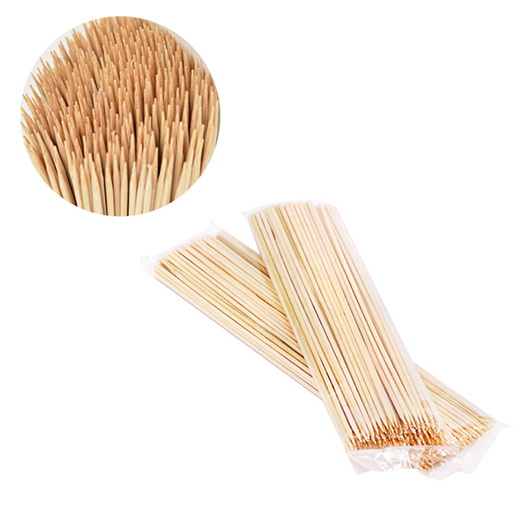
Optimized carton packing density: Loose packing wastes container volume. Gorlando bundles skewers in 100-piece vacuum-sealed or compressed packs, raising container loading efficiency by 18% to 22%.
-
5-ply heavy corrugated cartons and moisture protection: Shipments are packed in 5-ply K=K corrugated boxes with inner PE moisture bags and industrial desiccants, keeping cartons intact and mold-free over 40-day sea routes.
Frequently Asked Questions for Catering and Wholesale Buyers
Q1: Why does meat spin around round bamboo skewers when chefs try to flip them on the grill?
Answer: Heavy meat cuts or melted fat reduce surface friction, causing round skewers to rotate inside the food without turning it. Upgrading to Gorlando flat skewers fixes this because the flat rectangular profile locks into the meat fibers.
Q2: What should restaurants do if bamboo skewers char and break at the grill edge?
Answer: First check if the diameter is too thin for the food load; heavy meat requires at least 3.5mm thickness. Next, advise kitchen staff to pre-soak skewers in warm saltwater, or switch to paddle skewers where the wide handle rests outside the direct heat zone.
Q3: How does a manufacturer prevent bamboo skewers wholesale shipments from molding during ocean freight?
Answer: Gorlando kiln-dries all products to an exact 8% to 12% moisture range, packs them with industrial-grade moisture absorbers, and seals each carton with heavy PE liners to resist temperature fluctuations at sea.
As a direct manufacturer of disposable bamboo tableware, Gorlando supplies importers and distributors with OEM production, custom bamboo skewers sizes, flat skewers, paddle skewers, and branded packaging. If you need factory pricing, free testing samples, or container payload calculations for your next order, contact the Gorlando team today to discuss your sourcing requirements.
Restaurant Supply Guide: Individually Wrapped vs. Bulk Bucket Toothpicks — Maximizing Hygiene and ROI
Burr Removal and Polishing Process for Bamboo Skewers: Why Do Details Make a Difference in the Dining Experience for Customers?