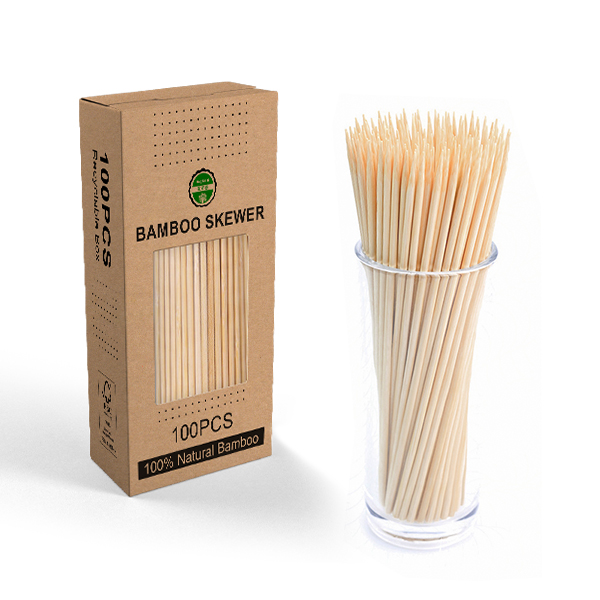
The Advantages of Custom Packaging for Customized Bamboo Toothpicks
2023-05-05
In today's competitive market, customized packaging has become a necessity for businesses to stand out from their rivals. This is especially true for businesses offering unique products such as customized bamboo toothpicks. Custom packaging not only adds to the product's visual appeal but also provides a significant marketing opportunity. It helps in brand recognition and customer loyalty. Additionally, custom packaging can help protect your products during shipping, minimizing the risk of damage. In conclusion, customized packaging is an investment worth making for businesses wanting to make a lasting impression on their customers, while also protecting their products.

The bamboo strips are covered in abundance, and the greenery is lush and serene. Among the 1642 known bamboo plants worldwide, China has over 800, making it the "Bamboo Kingdom". As of October 2021, the bamboo forest area in China has exceeded 100 million acres, and the annual production of bamboo is about 40 million tons. However, this figure only accounts for about 1/4 of the recoverable amount of bamboo forests, and there is still a large amount of bamboo resources idle.
Bamboo is meant to be 'chopped', "said Fei Benhua, director of the International Bamboo and Rattan Center and president of the China Bamboo Industry Association, in an interview with reporters. Bamboo is a precious and renewable resource bestowed on humans by nature. Scientific and reasonable harvesting of bamboo not only does not damage the growth of bamboo forests, but also adjusts the structure of bamboo forests, improves their quality, promotes stable and high yield, and fully utilizes the ecological, economic, and social benefits of bamboo forests.
In the conference room of the International Bamboo and Rattan Center, items such as bamboo tables, chairs, bamboo pen holders, and tissue boxes are within reach. Fei Benhua told reporters that while bamboo utensils meet the needs of a better life and improve the quality of the living environment, they are actually one "carbon fixing tool after another".
In the current era of global collusion for green development, bamboo is a natural wealth that can be greatly utilized. With the vigorous development of China's bamboo industry, the management, utilization, and technological innovation of bamboo resources are increasingly leading the world. The "bamboo plan" full of Chinese wisdom reflects the infinite possibilities of a green future.
Green Bamboo Yiyi - "The Infinite Treasure of Creators"
From deeply buried shoots to towering stems, the growth of bamboo is not as silent as that of trees. Research shows that bamboo can grow at a maximum speed of 1.21 meters in a day, with an average of two to three months to complete coarse growth and three to five years to become a forest. Within its natural lifespan, bamboo is like a self renewing "perpetual motion machine" that shoots every year.
There is a group of vibrant "perpetual motion machines" that have replaced the roaring coal mining equipment and become the "new owners" of the northern mining area of Feicheng, Shandong. Originally, although Feicheng used to thrive on coal, the collapsed land formed after coal mining left an ugly "scar" on this small town. In order to implement ecological restoration, under the guidance of experts from the International Bamboo and Rattan Center, Feicheng has carried out the "Bamboo Green Mining Area" campaign year after year, fully leveraging the advantages of short bamboo growth cycle, good landscape effect, and diversified products. Bamboo forests have been planted on coal mining collapsed land, turning a barren land into an ecological paradise for citizens to enjoy and play with bamboo.
It's not hard or soft, it's not grass or wood. It's either lush sand or water, or it's rocky land. Ancient people looked at bamboo and looked at its upright posture, calling it dignified and graceful. In the long years when Chinese people made friends with bamboo, they not only upheld the humble, upright, and resilient character of bamboo, but also discovered its various uses in architecture, daily necessities, food, and other fields, becoming pioneers in the development and utilization of bamboo resources.
"Bamboo grows fast and has high photosynthetic efficiency. Bamboo can reach the maximum carbon storage in about five years, and its material quality also grows to the best level. At this time, it should be cut in time to fix carbon storage in bamboo or bamboo products." Fei Benhua said that when bamboo is prepared into buildings, furniture and other products, it has a long-term carbon sequestration effect on carbon dioxide, among which bamboo building materials can retain carbon for up to 50 years, Furniture can generally sequester carbon for 20 years. This means that bamboo with a shorter lifespan can prolong the "professional life" of carbon storage and sequestration after being harvested, processed, and recycled. Compared to the cost of technologies such as carbon capture, bamboo clearly provides a striking "natural based solution".
Bamboo utensils
In order to maximize the carbon sequestration time of bamboo products, Fei Benhua suggests using the concept of "large timber for large use, medium timber for medium use, small timber for small use, and recycling" to harvest and utilize bamboo resources. Bamboo should be classified for harvesting and utilization based on its size. After the large area of bamboo used in construction reaches its service life, it can be recycled into secondary and tertiary products such as furniture, guardrail grilles, paper, and even biochar, which is of great significance for emission reduction and carbon reduction, "said Fei Benhua.
Turning Bamboo into Gold - Bamboo Industry Helps Green Development
From tissues, straws, tableware, incense sticks, to building materials and truck floor panels, various bamboo products from China are selling well in many countries around the world. Correspondingly, the development of China's bamboo industry is accelerating, and the supply capacity of high-quality bamboo products and services is strengthening. Statistics show that the output value of China's bamboo industry has increased from 82.97 billion yuan in 2010 to 321.798 billion yuan in 2020. By 2035, the total output value of the national bamboo industry will exceed 1 trillion yuan.
Bamboo winding composite material is a bio based material independently developed and fully intellectual property owned by China, which can be used to make pipe gallery facilities in water conservancy, municipal, transportation, and other fields. Fei Benhua told reporters that compared to traditional pipes made of cast iron and other materials, bamboo wrapped pipes have advantages such as light weight, good toughness, high strength, and biodegradability. It is understood that if bamboo wrapped composite materials are used to replace high energy consuming and polluting materials such as cement, steel, and plastic, the carbon reduction effect is very obvious: replacing spiral welded pipes with bamboo wrapped composite pipes with an annual output of 10 million tons can reduce carbon dioxide emissions by 52.23 million tons.
Bamboo winding pipe gallery
For many years, China has not only worked hard to cultivate its own advantages in the bamboo industry, but also helped countries and regions with abundant bamboo resources to lift themselves out of poverty and improve the environment by sharing technology and experience in the development of the bamboo industry.
On July 7th, a training course on the design and processing of bamboo furniture and lighting fixtures was launched online. 58 students from Ecuador studied with experts from the International Bamboo and Rattan Center, Beijing Forestry University, and some bamboo enterprises to learn about China's advanced craftsmanship and technology.
It is understood that the International Bamboo and Rattan Center has held four bilateral international training courses for Ecuador in recent years, covering topics such as bamboo processing, sustainable development of the bamboo industry, and innovative utilization of bamboo resources in post disaster reconstruction. A total of nearly 200 senior officials and technical personnel have been trained. Previously, the Eritrean side proposed to learn bamboo weaving technology, and the Chinese side sent experts to on-site understand the local bamboo resource types and site conditions, develop specific training plans, and facilitate Ecuadorian practitioners to obtain local materials, increase the added value of handicrafts through bamboo weaving, and obtain tangible benefits.
Opening Ceremony of the Training Course on Design and Processing of Bamboo Furniture and Luminaires in Ecuador
Not only Ecuador, China's "circle of friends" sharing opportunities for the development of the bamboo industry is expanding. In Africa, China strongly supports the "African Small Farmers Livelihood Development Project" initiated by the International Bamboo and Rattan Organization, which provides technical training to small farmers in Ghana and other regions to impart their experience in protecting, planting, logging, and managing bamboo forests, helping them enter the bamboo product value chain. In the future, the China Africa Bamboo Center will be located in Ethiopia to carry out comprehensive scientific research and training work, helping Africa better develop its bamboo and rattan industry.
Fei Benhua said that in order to further explore the path of achieving win-win ecological and economic benefits of bamboo forests and help the high-quality development of the bamboo industry, he will try to build a bamboo forest reservoir, money bank, grain bank and carbon bank eco economic demonstration area in the future, give full play to the better model of multiple benefits of bamboo forests in the pilot, and add Chinese wisdom to the green development of the bamboo industry.
Replacing Plastic with Bamboo - Green Initiative Goes to the World
For bamboo, June 24th this year is a day of great significance.
On that day, the "Replacing Plastics with Bamboo" initiative proposed by the International Bamboo and Rattan Organization was included in the list of outcomes of the Global Development High Level Dialogue, and will be jointly initiated by China and the International Bamboo and Rattan Organization to focus on reducing plastic pollution, addressing climate change, and promoting global green development.
According to an assessment report released by the United Nations Environment Programme, out of a total of 9.2 billion tons of plastic products produced worldwide, approximately 7 billion tons have become plastic waste, with a recycling rate of less than 10%. Finding plastic substitutes is an effective way to reduce plastic usage, reduce plastic pollution, and solve this problem from the source.
Why is it bamboo?
As a widely growing biomass material, bamboo has great potential in promoting global green development. Bamboo has a wide range of uses and can be fully utilized, with almost no waste. Bamboo products are diverse and rich, with over 10000 types of bamboo products developed, covering various aspects of people's production and life such as clothing, food, housing, and transportation. "Lu Wenming, Deputy Director General of the International Bamboo and Rattan Organization, told reporters: More importantly, bamboo products maintain low carbon levels or even negative carbon footprints throughout their entire lifecycle. From the perspective of carbon sequestration, bamboo products have a negative carbon footprint compared to plastic products. Bamboo products can be completely naturally degraded after use, better protecting the environment and human health
Green and green bamboo are natural. Bamboo plays a unique role in addressing a range of global challenges, with 7 out of 17 United Nations Sustainable Development Goals closely related to bamboo, including poverty eradication, affordable and clean energy, sustainable cities and communities, responsible consumption and production, climate action, terrestrial life, global partnerships, and more.
Protection is for better development, development is for better protection, and protection and development are eternal themes of human society. With the technological innovation in the utilization of bamboo, the application of bamboo will become more widespread, and the field of replacing plastic will also become wider. Its empowerment in production, life, and various industries will also become stronger, "said Lu Wenming.
Introducing the New Single Box Package for Toothpicks
The production process and tutorial of handmade wooden spoons