Bamboo Skewers for Automated Satay Production Lines: Solving Spinning Meat Problems & Dimension Optimization of Paddle Skewers and Flat Skewers
2026-06-11
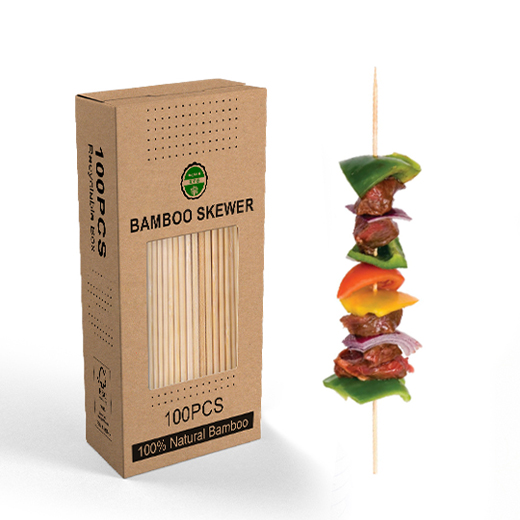
Walk into a large-scale food processing workshop, and you will see automated skewering machines running at full speed to finish food stringing. However, many production staff encounter a persistent problem: ingredients keep spinning on bamboo skewers. Though it seems trivial, this issue disrupts baking and conveying processes throughout production. With years of experience in custom catering skewers, Gorlando analyzes the root causes and optimization solutions based on abundant on-site production tests.
Production Hazards Caused by Spinning Meat
In mass production mode, ingredients circulate through multiple processes with bamboo skewers. Continuous rotation of meat will impact the entire production line, far beyond just affecting appearance.
Uneven Cooking of Ingredients During Baking
When meat chunks spin repeatedly on bamboo skewers, their heated surfaces keep shifting inside the oven. Some parts get overcooked and crispy, while the inside remains undercooked. Batched products vary greatly in taste, making it impossible to maintain consistent quality and unified production standards for processing lines.
Frequent Errors in Automated Conveying & Visual Inspection
Conveyor tracks and intelligent detection systems in modern production lines have strict requirements for the posture of meat skewers. Rotating skewers deviate from the preset position and trigger misjudgment of visual recognition systems, which often mark normal skewers as empty or defective. The equipment will alarm and shut down temporarily. Staff have to conduct repeated manual checks, raising labor costs and interrupting production flow.
Declined Stability of Mass Production
After long-term high-frequency operation, spinning skewers are likely to rub against equipment and adjacent products. This may cause ingredients to fall off or get damaged, or even jam conveyor components, shortening the service life of machines. No production team wants bamboo skewers to become a bottleneck restricting overall production capacity.
Structural Principles & Resistance Performance of Different Bamboo Skewers
Why do round skewers, flat skewers and paddle skewers perform so differently in fixing meat? Actually, the answer lies in cross-section shape, contact area and friction coefficient, which directly determine the overall torque resistance.
Traditional round skewers feature a standard cylindrical cross-section. They only make linear contact with meat without lateral clamping structures. When ingredients shrink after heating and dehydration, torque is generated. The smooth surface fails to provide effective resistance, so meat keeps rotating along the skewer.
Flat bamboo skewers adopt a totally different design. The flat surface and side edges embed into meat fibers, turning linear contact into surface contact. The expanded contact area raises the overall friction coefficient, and edges create physical clamping to offset torque effectively and limit the shake and rotation of ingredients.
Custom paddle skewers have a split design of handle and body. The widened flat handle at the tail assists automated skewering machines with positioning and feeding. The narrow flat body at the front balances piercing fluency and clamping ability. It delivers outstanding torque resistance when used for large meat ingredients.
During visits to numerous processing workshops, we noticed that many manufacturers only focus on the thickness of bamboo skewers, while ignoring the influence of cross-section structure on automated production. This is a major reason why the spinning problem keeps recurring.
Performance Comparison of Mainstream Bamboo Skewers
We conducted hundreds of tests under different line speeds and ingredient types. The table below shows the comprehensive performance of mainstream skewers, clearly reflecting their anti-spinning ability and application suitability:
| Skewer Type | Specifications | Relative Contact Area | Friction Coefficient | Average Meat Spinning Rate | Feeding Smoothness for Automated Skewering Machine |
|---|---|---|---|---|---|
| Standard Round Skewer | Diameter 3.0mm-4.0mm | Baseline 100% | 0.18 | 25% | Excellent |
| Regular Flat Skewer | 4.0mm Width × 1.3mm Thickness | 140% | 0.35 | 2.8% | Good |
| Wide Flat Skewer | 5.0mm Width × 1.4mm Thickness | 158% | 0.41 | 1.2% | Good |
| Standard Paddle Skewer | 9.0mm Wide Flat Handle, 3.5mm Wide Skewer Body | 162% | 0.45 | <0.5% | Excellent |
Skewer Selection Guide Based on Ingredients & Production Lines
Choosing suitable bamboo skewers requires comprehensive consideration of ingredient texture and production line speed, instead of relying on a single parameter. Based on years of customization experience, we sort out practical selection suggestions:
- Frozen poultry and small diced meat: Soft texture and small size. Regular flat skewers of 4.0mm×1.3mm are ideal for balanced cost and performance.
- Fresh beef, thick-cut mutton and other large juicy ingredients: Dense fiber and heavy weight bring stronger torque. Paddle skewers are recommended for reliable torque resistance to fix ingredients firmly.
- High-speed automated production lines: Skewers need smooth lines to avoid feeding jams. Round skewers or paddle skewers are the top choices.
- Low-speed precision processing lines: Wide flat skewers work better to minimize spinning and guarantee product appearance.
In fact, surface treatment also affects the using experience. Gorlando applies 360° drum deburring and polishing technology to all customized bamboo skewers. The polished smooth edges prevent ingredients from being scratched and avoid equipment jams caused by burrs, ensuring stable operation of the whole automated system. We can also adjust the overall size and shape of bamboo skewers one-on-one according to the model of customers’ automated skewering machines and production line layout.
Practical Tips to Optimize Using Experience
Proper skewer selection is the foundation to solve the spinning issue, and reasonable operation will bring better results. Match the thickness of cut meat with the width of bamboo skewers to improve fitting tightness. Meanwhile, control the spacing between ingredients on each skewer to avoid extra torque caused by mutual extrusion. These simple adjustments can greatly optimize the actual using effect.
Frequently Asked Questions (FAQ)
Q: Can thickening bamboo skewers stop meat from spinning? A: Simply thickening round skewers has limited effect. The core defect of round skewers is the lack of clamping edges. Even if the diameter increases, the friction coefficient will not rise obviously, and torque will still drive meat to rotate. Replacing with flat skewers or paddle skewers is a more effective solution.
Q: Do faster production lines set higher requirements for bamboo skewers? A: Definitely. Higher running speed of automated skewering machines and conveyor tracks increases centrifugal force and torque on ingredients. For high-speed lines, paddle skewers or wide flat skewers are preferred, as their superior torque resistance adapts to harsh working conditions.
Q: Does deburring treatment help reduce meat spinning? A: It offers auxiliary improvement. Smooth bamboo skewers without burrs will not scratch or pry ingredients randomly, cutting down irregular shaking. However, it is only a supporting optimization and cannot replace the anti-spinning effect brought by cross-section structure.
Q: Can different types of bamboo skewers be used on the same production line? A: Mixing different skewers is not recommended. Differences in shape and weight will disturb the feeding rhythm of automated skewering machines, easily leading to equipment failure and inconsistent quality control standards.
High-quality bamboo skewers act as a vital link connecting ingredients, machines and finished product quality. In automated food processing, minor optimizations on size, structure and technology can eliminate numerous hidden troubles for production lines. Specializing in customized catering skewers, Gorlando matches the most suitable products for various production scenarios with verified test data and practical experience, helping every production line run stably and efficiently.
What Are the Advantages of Disposable Chopsticks With Anti-Slip Grooves? Premium Japanese Restaurant Sushi Chopsticks Guide
Bamboo Chopsticks Ocean Shipment Mildew Loss Prevention: Multi-dimensional Moistureproof Solutions to Avoid Compensation Claims